






hot challenges

QQPKHUB PWA Feature Launch
Jelly Express
NLHE Texas Leaderboard
MTT Sharing Challenge

Forum Hot

🔥 Editor's Pick
PokerDream
Triton ONE
Beginner’s Guide
Daily Sharing
Knowledge Zone
Hand History Sharing
Lv.10

Differences between Cash and MTT and key considerations

Cash games (Cash) and multi-table tournaments (MTT) are both forms of Texas Hold’em, but fundamentally they are two different games. Many players lose money when switching between the two because they use a cash game mindset to play MTT, or an MTT mindset to play cash games.Below, I will help you fully understand the core differences from three dimensions: mindset, gameplay, and bankroll.---1. Fundamental differences in mindsetDimension Cash (Cash) MTT (Tournament)Who are you battling Opponents at the table Blind structure + all participantsChip value 1BB = 1BB, linear value Diminishing marginal utility, early chips are less valuable than later onesTime dimension Can leave anytime, unlimited rebuy Must play to the end, huge time investmentSource of profit EV accumulation per hand Survival + final table explosionBiggest enemy Yourself (emotion, discipline) Rising blinds + bubble pressureIn one sentence:· Cash games are a marathon, focusing on long-term consistency· MTT is like boxing—you may get beaten early, but if you land the final KO punch, you win the championship---2. Core differences in gameplay1. Starting hand rangesScenario Cash MTTDeep stack (>100BB) Can play small pairs and suited connectors with implied odds Playable early but cautiouslyMedium stack (40-80BB) Standard range Tighten to avoid marginal handsShort stack (Key difference: In MTT, as stacks get shorter, your shove range widens; in cash games, short stacks should tighten (since you can always rebuy, no need to risk marginal hands).2. Post-flop aggressionDimension Cash MTTBluff frequency Higher, multiple bluffs possible Lower, especially near the bubbleValue betting Thin value bets acceptable Bet only when confident to avoid being raisedDraw handling Can call based on odds Early playable, later must consider survivalBluff catching Common, especially vs aggressive players Rare, because losing means eliminationKey difference: Survival is more important than pot winning in MTT. In cash, you can rebuy after losing; in MTT, you're out.3. Bubble vs non-bubbleThis concept exists only in MTT.Stage StrategyEarly Play similar to cash gamesMid Tighten, avoid large swingsBubble Extremely tight, only premium hands. Big stacks apply pressure, small stacks surviveFinal table Aggressive again due to prize jumpsCash games have no bubble, so survival is not a concern.4. Stack depth dynamicsCash MTTFixed stack (can rebuy to 100BB anytime) Stack constantly decreases (blinds rise)Stable strategy Must adjust dynamicallyDeep stack skills important Short stack push/fold more importantKey difference: MTT players must master 10-30BB push/fold; cash players may rarely use it.---3. Bankroll management differencesDimension Cash MTTRecommended bankroll 20-40 buy-ins 100+ buy-insVariance Medium Extremely highRisk of ruin Low HighTime cost Low Very highExample:· Cash NL2: $40 with 20 buy-ins is sufficient· MTT $1: $100 with 100 buy-ins is barely enoughWith a $30 bankroll, you can only play 30 MTTs. This is extremely risky and likely to bust before learning anything.---4. Mindset transition checklist (must read)From Cash to MTT:1. Survival > pot winning Marginal hands can win pots in cash, but can eliminate you in MTT.2. Give up +EV calls In cash, good odds = call; in MTT bubble, even good odds may require folding.3. Accept boredom You may fold for hours—patience is key.4. Accept variance You may brick 20 tournaments then win one big.From MTT to Cash:1. Cannot wait forever Blinds don’t rise, but rake eats you.2. More bluffing needed3. No survival concept Every hand is EV-based.---Final note:Cash and MTT are not opposites but tools. Cash builds skills; MTT builds mindset and strategy. Master cash first, then move to MTT for bigger wins.

Lv.10

Fast play or slow play?

When to play fast vs when to slow play~~~~~~In tournaments, fast play means building the pot aggressively through bets and raises; slow play means checking or calling to disguise strength and induce mistakes.,,,Because blinds keep increasing and survival pressure exists, decisions are more influenced by stack sizes and board textures than in cash games.,,,Core breakdown:1. When to play fastFast play is the default in most situations, as it maximizes value and protects your hand.~Wet boards: When the flop has many straight or flush draws (e.g., 8♣ 9♣ J♦), you must fast play strong hands to extract value and avoid being outdrawn.~Calling stations: Against players who love calling, slow play wastes value. Bet and make them pay.~Stack dynamics: As a big stack, fast play pressures medium stacks. As a short stack, you don’t have time to slow play—look for spots to go all-in.~Balancing bluffs: Fast playing strong hands makes your bluffs harder to read.,,,2. When to slow playSlow play is a low-frequency tactic used for traps.~Dry boards: On boards like A♠ 7♦ 2♣ with a set, opponents rarely have draws, so checking can induce bluffs.~The nuts: If you have an unbeatable hand (e.g., AA on A-K-2 rainbow), slow playing allows opponents to catch second-best hands.~Aggressive opponents: Let them build the pot for you by checking or calling.~Protecting your checking range: Mixing strong hands into your checks prevents opponents from attacking you relentlessly.,,,3. Tournament-specific factors:~Early stage: Deep stacks allow flexibility; fast play builds pots, slow play can trap aggressive players.~Bubble: Strongly favor fast play to exploit opponents’ fear of busting.~Blind levels: Low blinds allow slower play; high blinds require aggression.。。。Summary:,,,Better to fast play and miss some value than to slow play and get outdrawn.,,,In tournaments, maximizing value is everything. If unsure, fast play is usually the safer professional choice. Only slow play when you are confident opponents will put money in or bluff aggressively.

Lv.7

Review of last night's community glory tournament

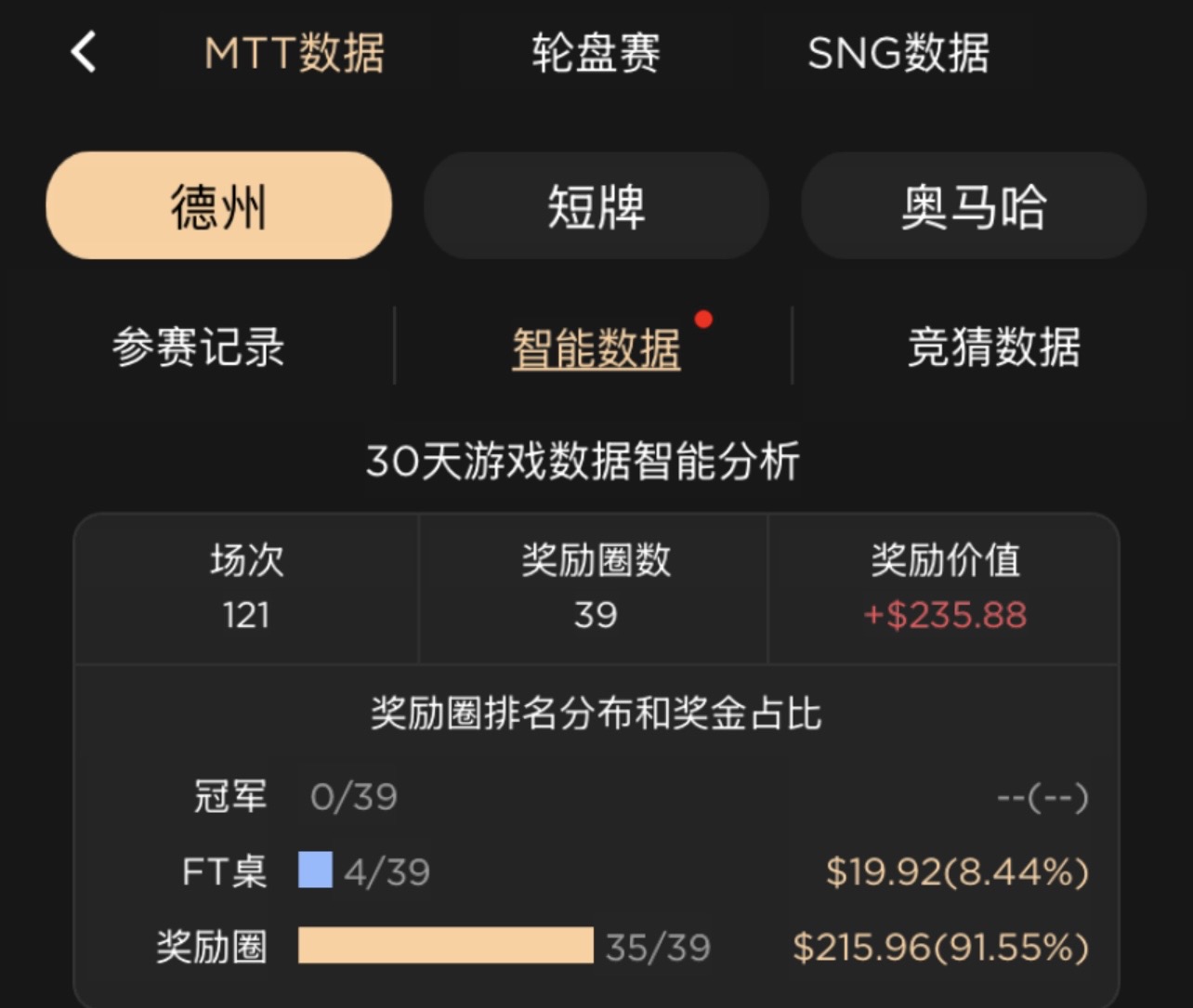
Last night’s community glory tournament only had 8 players. After checking the rewards, it was equivalent to having a guaranteed 2.2 T-coins, but unfortunately the payout jump only started from third place. I treated it as a proper FT and played seriously, with the first goal being top 6, then top 3…However, things did not go as planned, luck was not on my side. Below are the hand records.The starting stack was only 4000, which was fair for everyone, but the hole card quality was quite average. I barely felt involved throughout the whole tournament, and in the end, luck was also very bad.FT:1 (FT hand 1)TT, early position open likely stealing my blind, I directly shoved based on his fold equity. ps: I remember when peeking at the board it seemed the T only came on the river, if I had called, facing his cbet on such a board, I might not have been able to hold on.FT:9 (FT hand 9)AKo, this AK was folded after a long tank when UTG opened and middle position went all-in. Middle position QQ hit a set and eliminated UTG, deciding 8th place. For me, it was a lucky escape.FT:17KK, a rare premium hand. I was on the button, but everyone before me folded as if they could see my cards. I had no choice but to limp, hoping to get some value from SB and BB, but SB surprisingly didn’t even complete 1bb, completely opting out. BB also checked, and on the flop my half-pot mixed bluff frequency cbet pushed him out. Unfortunate! But better than getting no action.FT:28, 29Purely relied on opponents folding, all hands ended preflop. You could say no one has seen my hole cards yet, meaning I haven’t won at showdown.FT:33ATo, I originally wasn’t afraid to go broke with this hand, but considering my first goal was top 6, facing a late position all-in covering most of my stack, I chose to fold after a long tank. ps: it’s too tough, these players shove on me whenever I open, unlike when they open against each other where they peacefully see the river.FT:37This hand A6 opened to 2bb and got called by big blind’s remaining 500 (about 2bb) all-in. Nothing hit, 7th place was decided. First goal achieved, preparing to change strategy, just preparing though, since the dealing system at this table doesn’t seem to favor me.FT:3986s defended the blind boldly, planning to make a move, but with three players in the pot and a completely blank flop, I had to give up.————Spectating the bloody battle unrelated to me————A weak player ran extremely hot, eliminating the chip leader and another strong player, leaving four players.FT:42AQo, I thought it was the horn of attack, but it turned out to be the scythe of death. I opened 3bb to 1500, and again got shoved on. Considering my first goal was achieved and I wanted to push for top 3 or even win, this was a necessary battle, and I covered the opponent, so I called all-in. Opponent had JJ, flopped a set to double through me, leaving me with only 2bb. I can only say: damn it.FT:43AA, naturally all-in. At that moment I wondered if folding AQo earlier and saving chips for this hand would have been better. Then CL called with 79s, and I watched helplessly as a 7 came on the flop and another 7 on the turn. This AA ended my run in 4th place. ps: damn it, again.

Lv.10

Change Your Playstyle

Change Your Playstyle>>>>>Being able to flexibly “change gears” based on the situation, or adjust your playstyle, is what separates advanced players from average ones. This change is not only to avoid being read by opponents, but also to proactively create profit opportunities.>>>Changing your playstyle mainly brings you the following four core benefits:1. Increase the difficulty for opponents to “read” you (unpredictability)If you always stick to one style (for example: a tight-aggressive style that only plays strong hands), smart opponents will quickly lock onto your hand range. Benefit: When you occasionally make large bluffs under a tight image, or slow-play strong hands under a loose image, opponents will find it hard to judge your strength based on your bet sizing. This*balancing (Balancing)** makes opponents uncomfortable and increases the chances of them making mistakes.2. Maximize exploitation of opponents’ weaknesses (exploitative strategy)Texas Hold’em is not played in a vacuum—different opponents have different leaks. Benefit: Against tight players (Nits): you can adjust your style to be more aggressive, frequently stealing blinds and betting post-flop to profit from small pots. * Against aggressive players (Maniacs): you can tighten your range and induce them to overbet when you hold strong hands, allowing you to stack them.3. Use your “table image” for reverse playYour performance over the past half hour leaves a strong impression on opponents. Benefit: If you haven’t entered a pot for the last ten hands, your image is very “tight”. At this point, switching gears and making a big bluff has a very high success rate, because opponents assume you “must have it”. * Conversely, if you have been very active recently (frequent raises), your image is “loose”. When you then pick up a premium hand (like AA or a set), switching gears and betting big often gets called, as opponents think you’re “messing around again”, allowing you to maximize value.4. Adapt to changes in game dynamicsEspecially in tournaments, as blind levels increase and stack sizes change, a fixed strategy will perform poorly. Benefit: Deep stack stage: you can play more speculative hands like suited connectors, using style adjustments to find opportunities to stack opponents. * Short stack stage: you need to switch to “push/fold” mode, using aggression to survive.>>>◇◇◇In short: the best strategy is to have no fixed strategy. Let your opponents always feel that you are a “mystery”, and you will control the game.

Lv.10

What is a stable poker player like?

What does it take to be considered a stable professional poker player? In MTTs, “stability” is a relative concept. Due to the extremely high variance in MTTs, even top professionals can experience “dry spells” lasting several months. To evaluate whether a player has truly achieved “stable profitability,” it is usually necessary to look at the following three dimensions: 1. Core quantitative metrics You shouldn’t look at single tournament results, but rather long-term statistics: * Return on Investment (ROI): This is the gold standard for measuring stability. * Over a sample of thousands of tournaments, an ROI of 10%–25% is considered strong and stable. * Formula: ROI = \frac{Total Winnings - Total Buy-ins}{Total Buy-ins} \times 100\% * In-The-Money percentage (ITM%): While higher is not always better (since chasing ITM may reduce chances of winning), stable players typically maintain around 15%–20%. * Volume: This is often overlooked. In MTTs, a profit record of fewer than 1000–2000 games is likely just “running good.” Only with a sufficiently large sample does the data become meaningful. 2. Bankroll Management The essence of stability is **“not going broke.”** * Buy-in reserve: A stable MTT player usually keeps at least 100 average buy-ins (ABIs). If you play $10 tournaments, you should have at least $1000 in your bankroll. * Variance tolerance: The ability to withstand 50 or even 100 consecutive tournaments without cashing (downswing) without affecting your mindset or altering correct strategy. 3. Consistency in technical execution Mental and strategic consistency is often harder than consistent results: * No Tilt: No matter how many bad beats you take, you can still make mathematically correct decisions in the next hand. * Strategic baseline: Having a complete strategy framework (such as RFI ranges at each stage, 3-bet logic, ICM pressure application), rather than playing based on “feel.” * Learning loop: Regular review sessions, checking whether key hands have positive EV (expected value), instead of only focusing on whether you won chips. ◇◇◇ Stages comparison ◇◇◇ 1. Lucky player (unstable) Occasionally wins a big score, then gradually loses it in smaller games, often jumping stakes. 2. Break-even player (pseudo-stable) High ITM, but rarely finishes top three (weak final table performance), ROI close to 0. 3. Professional / semi-professional (truly stable) Sample size > 2000 games, consistently positive ROI, strict bankroll management, continuous review.